


America's economy increasingly depends on whether you own stocks


America's economy is becoming a rather peculiar place. The stock market can create trillions of dollars in wealth, consumer spending can remain remarkably resilient, and economists can point to continued growth. Meanwhile, an increasingly large portion of the population looks at its bank account and wonders what fucking economy everyone else is talking about.
The latest University of Michigan consumer sentiment data offers a particularly revealing explanation.
Since January, sentiment has reportedly fallen 27% among the bottom third of stockholders, compared with 25% among Americans who own no stocks. Among the middle and top thirds of stockholders, however, sentiment has declined just 9% and 7%, respectively. Even owning stocks isn't necessarily enough to feel better about the economy anymore. Apparently, the amount you own matters quite a bit.
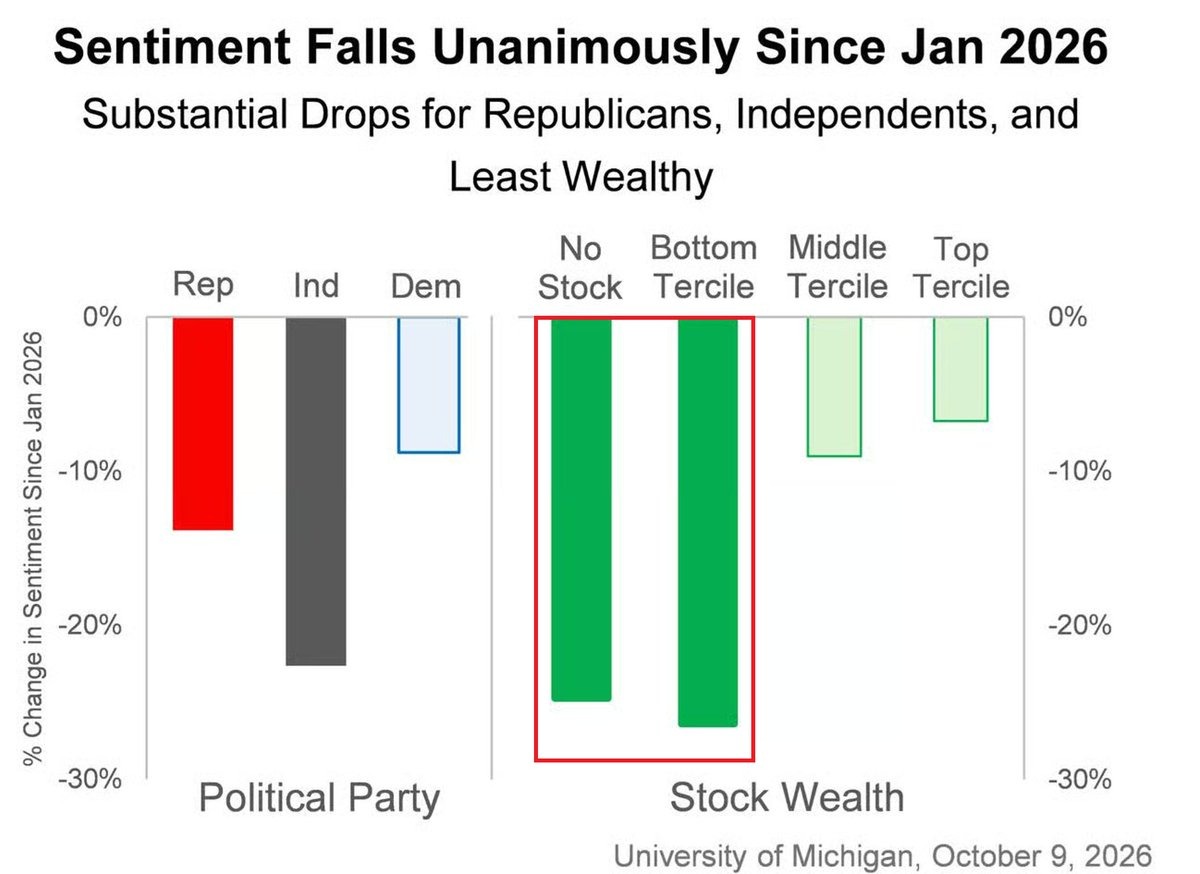
Overall consumer sentiment fell to 46.3 in October, approaching historic lows, while Americans' expected inflation over the next year climbed to 4.7%. That's not the actual inflation rate, but it shows how consumers expect their purchasing power to fare. And those expectations aren't particularly encouraging.
We've discussed this growing divide before, but the numbers are becoming increasingly difficult to ignore.
According to the Federal Reserve, American household wealth increased by a record $12.8 trillion in the second quarter, with nearly $11 trillion coming from stocks and other financial assets. Total household equity holdings reached approximately $74 trillion, and stocks overtook real estate as the largest asset on American household balance sheets.
Wonderful news, provided you actually own some.
The wealthiest 1% of Americans hold approximately 51% of all stocks and mutual fund shares, while the bottom half holds just 0.6%. Between late 2024 and mid-2026, the wealthiest 0.1% accumulated an average of nearly $30 million in additional inflation-adjusted wealth per household. The bottom half gained roughly $1,960.
That's a difference of more than 15,000 to one. You can appreciate the economic recovery considerably more when it's deposited directly into your brokerage account.
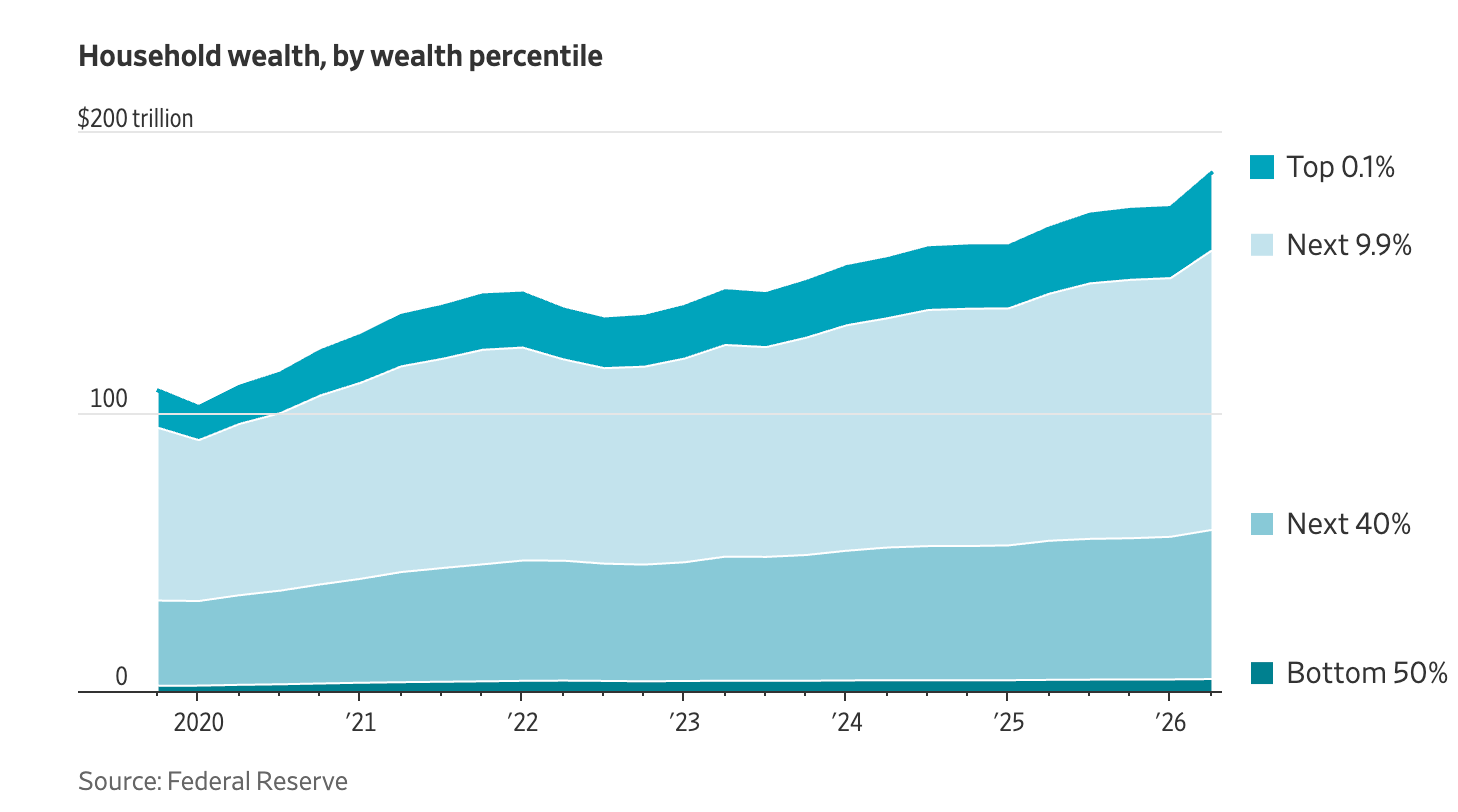
Visual source: WSJ
This divide increasingly affects the economy itself. Evercore ISI estimates that rising household wealth accounts for roughly half of recent American consumption growth. That's the wealth effect: People whose portfolios appreciate become more comfortable spending, even while higher prices and borrowing costs squeeze everyone else. It also helps explain why consumer spending can remain strong while consumer sentiment deteriorates. People who benefit most from rising asset prices are disproportionately able to keep the economy moving. Those without those assets must rely on wages to keep pace with expenses.
There's another complication: The latest inflation report showed consumer prices rising 3.7% annually in September. And higher inflation doesn't distribute its consequences evenly. Households spending most of their income on necessities have less flexibility to absorb another round of price increases, while households with substantial investments have an additional financial cushion.
None of this means the stock market is a guaranteed escape hatch. Stocks can fall, sometimes violently, and a market-supported consumption boom creates its own vulnerabilities. Nor does owning a few shares automatically insulate someone from higher grocery bills.
But the underlying message is becoming harder to dispute: Wages increasingly determine whether Americans can afford to live; asset ownership increasingly determines whether they can get ahead.
And when an economy's apparent prosperity depends heavily on appreciating assets that much of its population barely owns, perhaps we shouldn't be surprised when the economic statistics and the people living underneath them tell two very different stories.
Answers to your questions
Yes. WealthLuma offers partner access so you can manage your finances together at no additional cost. You’ll be able to filter transactions by member—making it easy to see which spending is yours and which belongs to your partner.

Yes. You can edit existing transactions and add new ones directly in WealthLuma, so your records stay accurate and personalized.
Origin connects securely through trusted partners including Plaid, MX, and Mastercard.
Yes. WealthLuma supports CSV uploads. You can upload a .csv file of your transactions, and we’ll import them into your account.
Yes. Your data is protected with bank-level security and advanced encryption. When you connect accounts through WealthLuma, your login credentials are never shared with us. Instead, our partners generate secure tokens that let WealthLuma access only the data you authorize—keeping your personal information private while enabling personalized insights.
Yes. You have full control to organize your spending in WealthLuma. Transactions are automatically categorized by WealthLuma, but you can always edit categories, add your own tags, and filter transactions however you like—so your spending reflects the way you actually manage money.